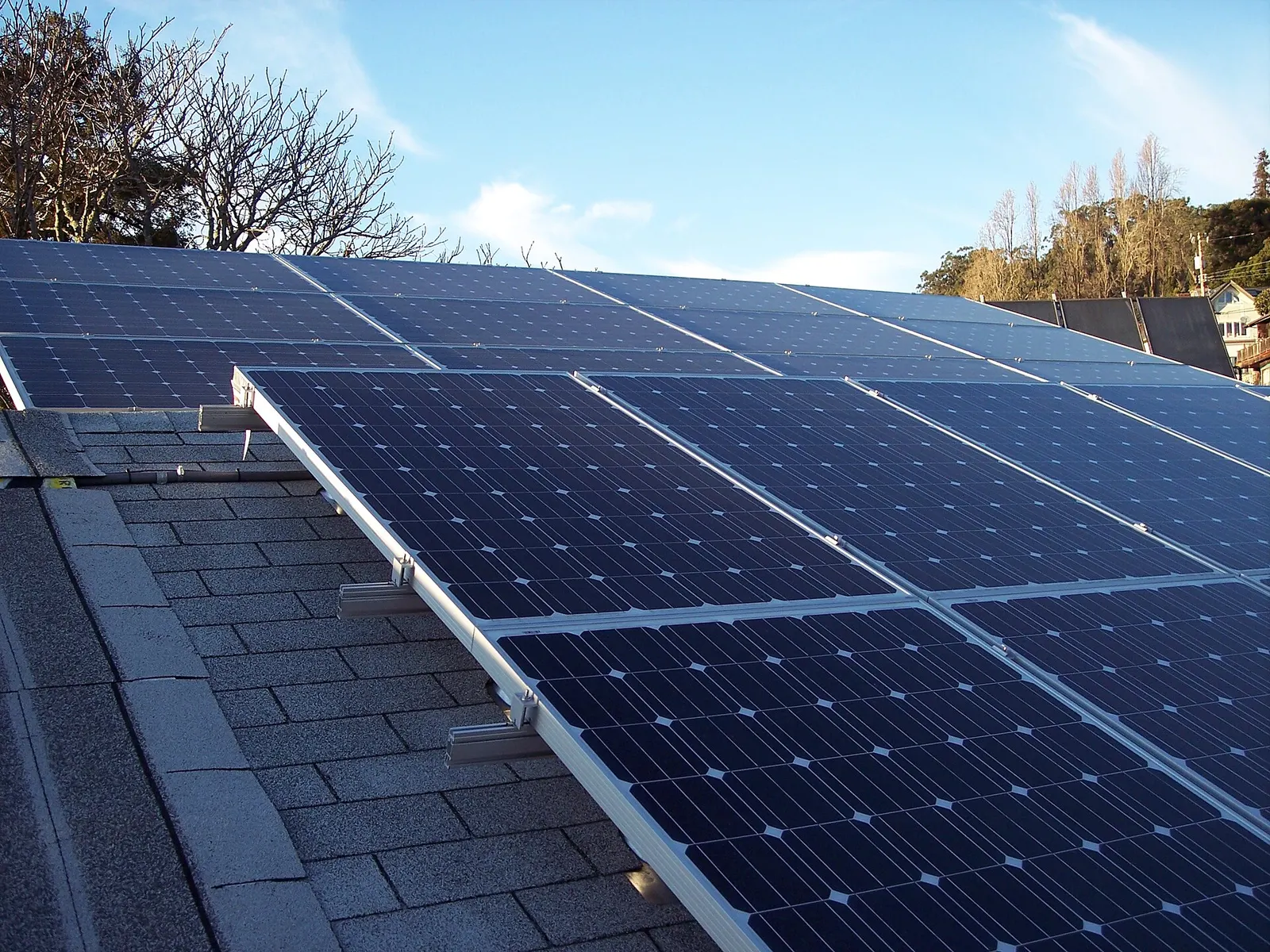
Date your roof before you compare Alpharetta solar quotes
Start with the invoice from the last time the shingles were replaced, or the seller's disclosure and inspection report if you bought the house. Don't expect the city to have a record. In Alpharetta a shingle-only reroof needs no permit, so a roof replaced without structural work may leave no permit trail at all. If you have no paper, a roofer can estimate the age from the shingles and the attic, but ask them to write "estimated" beside the date on the quote.
The date matters because panels are meant to stay put. The U.S. Department of Energy notes that during a roof replacement the panels and their mounting have to come off, and in a separate guide it puts panel life at about 25 to 30 years. ENERGY STAR comes at it from the other side: if the roof needs renovation, replace it before the panels go up. EcoGen's Georgia cost guide treats roofs older than about 15 years as replace-first candidates. That's a rule of thumb, not a measurement, but it's a useful line to test a quote against.
With the date in hand, you're choosing between three paths. Ask every installer to price the one they recommend and say why:
- Replace the roof first, then mount. You pay for the roof now. The panels go onto new shingles and new underlayment (the water-resistant layer under the shingles), and the timing problem goes away for as long as that roof lasts.
- Repair the array area, then mount. The roofer fixes the planes the panels will cover, such as soft spots or worn shingles, and leaves the rest. This only makes sense if the rest of the roof has years left; ask for the repair as its own line.
- Mount on the current roof, with the future job priced. You keep the roof you have and ask the installer to put the cost of removing and reinstalling the panels at the next reroof in writing. If they won't price it, the quote should say "not included", so you know the cost is still out there.
If the invoice shows a replacement in the last few years, the third path is usually the easy one. File that invoice with the solar paperwork.
To choose between the paths, take the roof line out of any bundled quote, divide the solar-only price by the system's watts and compare it with a state benchmark (worked example below). If the solar prices come out close, the choice comes down to when this roof gets replaced and who pays to move the panels then.
Why Alpharetta roofs and rules push the roof decision first
Two local facts sharpen the roof question here: when the housing was built, and what the city requires when a roof is replaced.
Housing age. In the Census Bureau's 2024 American Community Survey, the median year built for Alpharetta's housing units is 1998, and about 49% were built between 1980 and 1999. That count covers all housing units, apartments included, not only detached houses; the figures are on the Census Reporter profile for Alpharetta. For one house the arithmetic is simple. A 1998 house on its original shingles has a 28-year-old roof in 2026. One reroofed around 2010 is in its mid-teens, right where EcoGen's rule of thumb starts asking questions.
Roofing rules. The City of Alpharetta's Construction and Inspections page answers the roofing question directly:
- Replacing shingles without structural work may be done without a permit.
- Structural work, such as replacing sheathing, rafters or trusses, needs a permit. Sheathing, also called decking, is the plywood or board layer the underlayment and shingles are nailed to.
- Old asphalt shingles must be torn off before new ones go on. No layering over.
Put those rules together and you get the local trap. A shingle-only reroof is permit-free, but tear-off is exactly when soft decking shows up, and replacing sheathing turns the job into permitted structural work. If that happens on a house with solar planned, a roof permit and the solar paperwork can end up in front of the same city office at the same time, and the solar crew can't mount on a deck that's still being replaced. Find soft decking before the solar permit is filed, not halfway through the install.
The city's residential design criteria also rate decay risk as "Severe". That's one more reason to have the decking probed where the mounts will be bolted through, not just walked.
Worked example: take the roof line out of the quote
Illustrative example (invented prices, to show the method). A 1998 house in an Alpharetta subdivision, reroofed once in 2010, so the shingles are 16 years old in 2026. The city's tear-off rule means any reroof strips to the deck. The owner has two written bids for the same 8.0 kW DC array: 20 panels at 400 watts each.
| Illustrative example: quote line | Bid A: mount on current roof | Bid B: replace roof first |
|---|---|---|
| Roof replacement, city-required tear-off | not quoted | $11,100 |
| Solar equipment, labor, permits, interconnection | $22,800 | $22,800 |
| Future panel removal and reinstall | "not included" | not needed while the new roof lasts |
| Total on the quote | $22,800 | $33,900 |
| Total ÷ 8,000 W | $2.85/W | $4.24/W (misleading) |
| Solar-only price ÷ 8,000 W | $2.85/W | $2.85/W |
| EcoGen Georgia figure (State benchmark) | $2.78/W | $2.78/W |
Two terms on that table. DC watts is the panels' combined rated output: 20 × 400 W = 8,000 W, or 8.0 kW DC. A proper quote prints it. Price per watt ($/W) is the price divided by those watts, which lets you compare systems of different sizes.
The benchmark comes from EcoGen's Georgia solar cost guide: $2.78 per watt (State benchmark, September 2026 edition, prices as of September 25, 2026), for a typical 9.21 kW system at $25,604. EcoGen describes it as a modeled installed price before incentives, a state benchmark rather than a quote for your home. The method doesn't say whether it uses DC or AC watts, so divide by the DC watts on your quote and allow some slack near the line.
Illustrative calculation. Both solar prices sit about 2.5% above the state benchmark ($2.85 ÷ $2.78 ≈ 1.025), close enough that neither looks out of line on solar alone. Divide Bid B's full total by the watts and it looks 52% too high ($4.24 ÷ $2.78 ≈ 1.525). That number is wrong in a useful way: it's what a roof hiding inside a solar price looks like.
So the bids differ on the roof, not the solar. Bid A leaves 16-year-old shingles under an array DOE expects to last 25 to 30 years. Its hidden cost is the removal-and-reinstall job at the next reroof, with the mounts going back through a new roof, paid in exchange for using up the years left on the current shingles. Bid B's cost is retiring a 16-year-old roof early, in return for one tear-off and one set of roof penetrations for the life of the array.
Before you pick, ask Bid A to price that future removal and reinstall in writing, or confirm it's not included. Ask Bid B to keep roof and solar lines separate. If the roofer says the shingles have only a few years left, Bid A's savings are mostly borrowed. If the roof has a decade or more in it, Bid A can still win. There is no verified local removal-and-reinstall figure to print here, which is exactly why it belongs on the quote.
Who owns the flashing, mounts and future leaks
Every rooftop mount is a hole in the roof, and on a 1990s Alpharetta house the deck under it may be original. Any installer will say they seal the holes. What you need in writing is who answers for each one for as long as the panels are up.
Three terms. Penetrations are the holes drilled through shingles and decking for mount bolts. Flashing is the metal or composite piece that sheds water around each one. Underlayment is the water-resistant layer under the shingles, and it gets patched wherever a bolt goes through.
For asphalt shingle, mount options include flashed mounts lag-bolted into the rafters and rail-less systems with their own attachment. The right one depends on rafter spacing and deck condition, which is why the deck check comes before the mount choice. Given the city's "Severe" decay rating, ask for the deck to be probed at the planned mount points.
The city's tear-off rule adds a second date to this question. When the next reroof comes, every shingle around every mount comes off down to the deck. Someone then has to remove the panels, re-flash each mount on the new roof and reinstall the array. Ask now who that will be and what it costs, so the answer isn't left to whoever happens to be in business in fifteen years.
Then ask three things in writing:
- Who installs the flashing and underlayment patches: the roofer or the solar crew?
- Who answers for a leak at a mount in year three, and in year twelve?
- Does any existing roof warranty survive the drilling, and does the installer's coverage name the penetrations?
When the roofer and the solar installer are separate companies, each can blame the other after a leak. Settle it on paper before anyone climbs a ladder.
Check which office permits your "Alpharetta" address
Before you compare permit plans, confirm the City of Alpharetta is actually your permit office. An "Alpharetta, GA" mailing address doesn't prove the house is inside city limits.
One example is Halcyon: public reference entries on Alpharetta describe it as a Forsyth County development with an Alpharetta postal address, outside both the city limits and Fulton County. A house there follows Forsyth County's rules.
The paperwork changes too. Forsyth County's Electrical Only permit packet requires an engineer letter when solar panels go on the roof of an existing structure, and a Sawnee EMC interconnection form when Sawnee serves the home. Both apply only if your parcel is in unincorporated Forsyth County, and a quote written for a city house won't mention them.
How to check:
- Read the city or jurisdiction field on your county property record or property tax bill.
- City of Alpharetta: the rest of this page applies as written.
- Unincorporated Forsyth County: ask each installer who gets the engineer letter, who pays for it, and who files the Sawnee form.
- Another city, such as Milton: the permit route is different; see our Milton page.
Don't rely on a ZIP code. Make each installer confirm the jurisdiction in writing before they write the permit plan.
How a solar job moves through Alpharetta's permit office
A building permit covers the construction work itself. A trade permit covers one trade's part, such as the electrical work, and is pulled by that trade's licensed subcontractor.
The city's Residential Permitting Procedures set the order: building permits must be obtained before subcontractor trade permits can be issued. A trade permit stands alone only when no other work is associated, as with a water heater repair or an electrical service change-out. Rooftop solar isn't named in either category. A job with mounts on the roof and wiring to the panel looks like work with associated parts, so it would likely follow the building-first order, but the documents don't say so. Ask every installer in writing which permits the job needs.
The sequence, as the city's documents describe the steps:
- Written HOA approval first. The city strongly encourages homeowners in subdivisions with covenants to get written HOA approval before applying, and notes that most subdivisions in Alpharetta have covenants. HOA approval doesn't authorize construction by itself. Get the approval letter before anything is filed, and ask what panel color or placement the covenants require.
- Structural roof work needs a permit. If the decking check calls for new sheathing, that work is permitted under the roofing rule above.
- Building permit through the portal. Alpharetta accepts plans only electronically, through its Online Permitting Portal.
- Electrical trade permit after the building permit. The city's electrical application asks for the building permit number, the subcontractor's business registration number, and the Georgia card holder, card number and class. The 2022 form lists a $50 minimum fee. The quote should name who files it and whose card number goes on the form.
- Allow time for review. The city says to allow ten business days for plan review comments.
- Inspections, then the utility. Inspections are called in to the city's Inspections Division the morning of the inspection day. Georgia Power's interconnection application asks for the local inspection report where one applies, so the city's sign-off feeds the utility step.
The same document tells homeowners to have every contractor show a City-issued permit before work starts. Ask the roofer too, especially if decking is being replaced. What the documents don't settle: whether Alpharetta wants a structural or engineer letter for solar, and the total fee beyond the $50 minimum. Those answers belong on the quote.
Your power bill decides what exports are worth
Read the name at the top of your electric bill. For Alpharetta addresses it should be Georgia Power or Sawnee EMC; which one depends on the address, not on you. If it names a different utility, the figures below don't apply, so ask that utility for its export rate. The two pay very different amounts for solar power you send back.
Exports are the solar power your house doesn't use at that moment and sends to the grid. The export credit is what the utility pays per exported kilowatt-hour (kWh). It is not the retail rate you pay for power you buy, and it's why "your meter runs backward" is the wrong mental model in 2026.
Georgia Power. Its rooftop solar FAQ sets the 2026 export credit at 3.2188¢ per kWh plus a 4¢ adder, about 7.22¢. It uses instantaneous netting: solar you use as it's produced simply cuts what you buy, and only the surplus flowing out at that moment earns the export credit. Residential systems are capped at 10 kW AC (the inverter's output rating, not the panels' DC rating); the 8.0 kW DC example fits. Permission to operate (PTO, the written go-ahead to switch on) follows a witness test and a reprogrammed meter, and the PTO letter goes to customer and installer. The installer or the customer can file the application; the customer signs it. For a house inside city limits, the city inspection report from step 6 above is part of that file.
Sawnee EMC. Sawnee buys excess energy at 3.79¢ per kWh under its net energy metering rider, as reported by EcoGen in October 2026. Confirm the current rate with Sawnee before you rely on it.
| Illustrative calculation | Georgia Power | Sawnee EMC |
|---|---|---|
| Export credit in 2026 | 7.22¢/kWh | 3.79¢/kWh (as reported by EcoGen, October 2026) |
| Exports from the 8.0 kW example | ≈3,406 kWh/yr | ≈3,406 kWh/yr |
| Value of those exports | ≈$246/yr | ≈$129/yr |
The inputs: EcoGen's Georgia production factor is 1,419 kWh per kW per year (State benchmark), so 8.0 kW × 1,419 ≈ 11,352 kWh a year. Assume 30% is exported (an illustration, not a measurement) and that's about 3,406 kWh.
Now compare with what you pay. EcoGen's Georgia cost guide puts Georgia Power's average residential price at about 15.0¢ per kWh including riders, roughly twice the 2026 export credit. Check the price per kWh on your own bill. If it's higher than the export credit, each kWh used at home while the sun is up is worth more than one exported, which argues for sizing the system to your daytime use rather than to the whole roof. A quote that values all production at the retail rate overstates the savings on either utility. Two more 2026 facts:
- The export rate resets each year. Georgia Power's avoided-cost figure is set annually. Ask which year's rate the estimate uses.
- No federal residential tax credit for a system you buy and complete in 2026. The IRS says the Section 25D credit is not allowed for expenditures made after December 31, 2025, and an expenditure counts as made when installation is completed. A 2026 cash quote that still subtracts the old 30% federal credit is using outdated rules.
Proposed service: one plan for roof, mounts and wiring in Alpharetta
Proposed service. Maravegias and Sons Roofing and Solar is a proposed roof-and-solar service; coverage for Alpharetta is proposed and not yet confirmed. It would start with the roof, then plan the mounts and the electrical and utility path in one written plan.
Before the visit, the proposed service would ask you for a recent electric bill (it names your utility), 12 months of usage, the roof invoice or disclosure, any roof warranty, your HOA covenants and the parcel address.
Under the proposed service, we'd take an Alpharetta job in this order:
- Roof first. Date the shingles, check the attic, and probe the deck in the array area before anything is filed.
- Roof decision on paper. Price the three paths (current roof, repair the array area, replace first) as separate lines, with the roof kept out of the solar price.
- Mounts and penetrations. Choose a mount for asphalt shingle and name who owns each penetration, any future leak and the next removal and reinstall.
- Electrical scope. Mark the array layout with DC and AC kW, check the main electrical panel, and name the licensed electrical contractor whose Georgia card number goes on the city's trade permit.
- Permit route. Confirm jurisdiction from the parcel record, file the building permit through the portal, then the electrical trade permit after it.
- Utility path. Name Georgia Power or Sawnee EMC from your bill and track the job from city inspection to the PTO letter.
The proposed service would hand you six written deliverables:
- Roof condition report: remaining-life estimate, repair or replace-first recommendation, photos of each roof plane.
- Roof-first decision sheet: each path's line items, so you can run the per-watt check yourself.
- Penetration and flashing responsibility sheet: a named party for each item, with future removal and reinstall priced or marked "not included".
- Electrical scope: the electrical contractor named with a Georgia license number, and any main-panel upgrade as its own line.
- Permit plan: office, applicant, documents, inspection steps.
- Utility handoff sheet: utility, who files and signs, export credit used, PTO milestone.
Georgia requires a licensed electrical contractor for the electrical side of a solar job. Whoever you hire, ask for that contractor's Georgia license number. The full proposed service is on the home page.
Questions to ask any Alpharetta solar installer before you sign
Get written answers from every installer. The quote checklist on this site follows this order.
Roof
- How old is the roof, and what proves it: invoice, seller's disclosure, inspection report, or "estimated"? (A shingle-only reroof in Alpharetta needs no permit, so there may be no city record.)
- Which path does the quote assume: current roof, repair the array area first, or replace first?
- Will the decking be probed in the array area before the solar permit is filed? If sheathing must be replaced, who pays and who pulls that permit?
Price
- What is the roof line, and what is the solar-only price per DC watt? How does it compare with the $2.78/W state benchmark?
- What will removal and reinstall cost at the next reroof, or does the quote say "not included"?
Permits
- Is the parcel inside the City of Alpharetta? If it's in unincorporated Forsyth County, how are the engineer letter and Sawnee form handled?
- Which city permits does this solar job need, does the city want a structural or engineer letter, and what is the total permit fee?
- Is the HOA's written approval in hand before anything is filed?
- Who files the building permit through the portal, and who files the electrical trade permit after it? Whose Georgia card number and class go on the form?
- If the house is on the city's historic inventory, has anyone asked Community Development whether a certificate of appropriateness applies?
Electrical
- Who is the licensed electrical contractor, and what is their Georgia license number?
- Does the main electrical panel need an upgrade, and is it priced as a separate line?
Utility and money
- Which utility serves this address, and which year's export credit does the estimate use?
- What share of production does the estimate assume is exported, and at what rate?
- Who files the interconnection application, and when do I sign it?
- Does the price assume a federal tax credit for a 2026 cash purchase? If so, why?
Roof penetrations
- What mount type will be used on this asphalt-shingle roof, and how many penetrations?
- Who installs flashing and underlayment patches, and who answers for a leak at a mount, and for how long?
A quote that can't answer these isn't ready to sign.