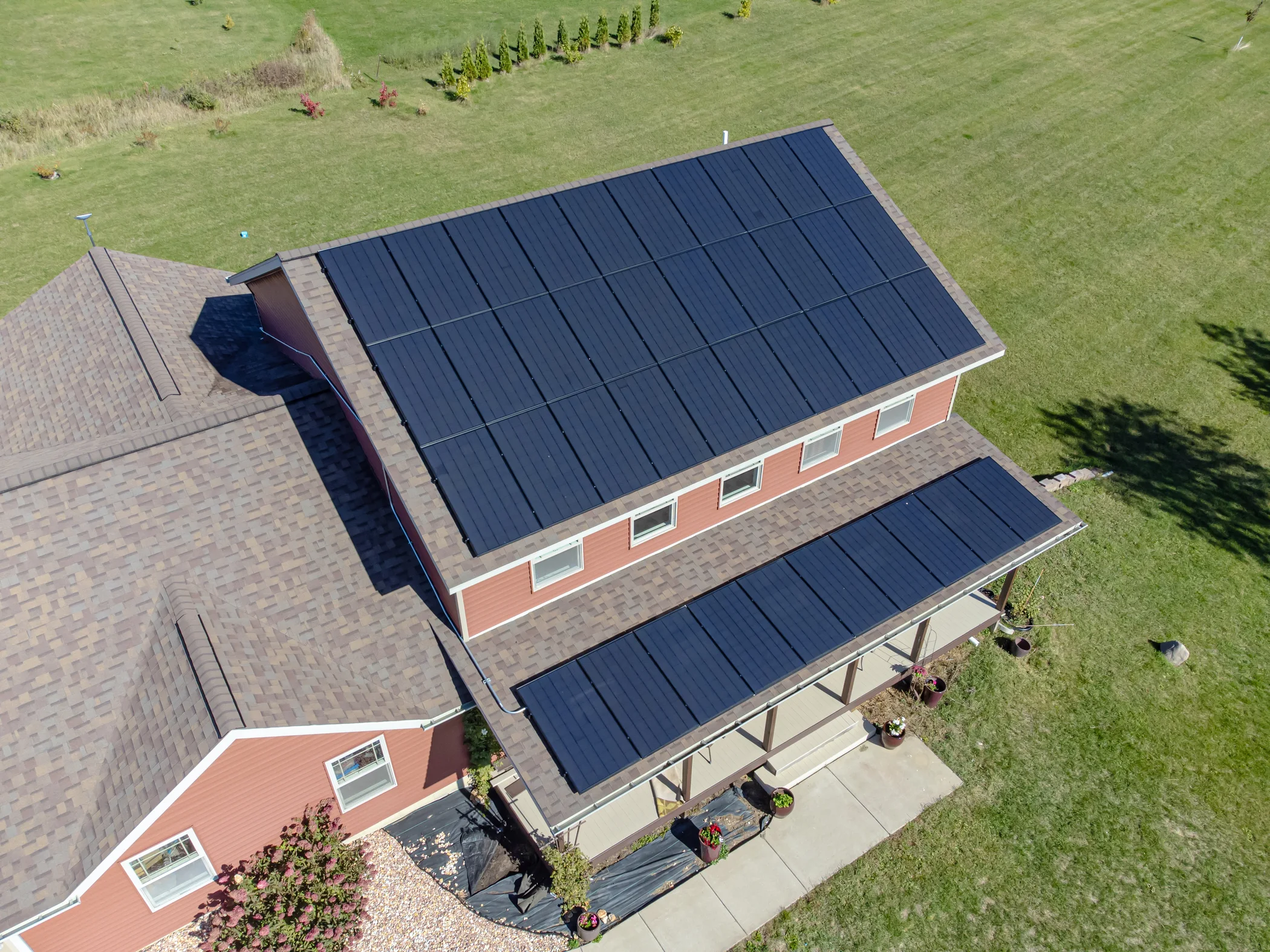
Seven documents we put in writing
A panel-only quote treats the roof as a surface to bolt onto. That leaves two questions open. Will the shingles outlast the panels? And if a mount leaks a few years in, who comes out: the roofer, the solar company, or nobody?
We answer both before anything is signed. It starts with the roof, prices roof work apart from solar, and names who is responsible for every penetration (a hole drilled through the shingles and roof deck to anchor a mount). Then it plans the electrical, permit and utility steps around your address.
What you get: every one of these documents is included, and each one is yours to keep.
Two local splits shape every one of these documents. Your parcel decides whether the City of Cumming or unincorporated Forsyth County issues the permit. Your bill decides whether Georgia Power or an electric co-op (an EMC) connects the system and pays for exported power.
The roof assessment comes first
Before anyone sizes a system, ask for a written roof assessment. The U.S. Department of Energy lists roof age, tree shade, and roof size, shape and slope among the first things to check, and notes that south-facing roofs pitched 15 to 40 degrees typically perform best. Our assessment goes further:
- Attic and deck. Soft decking (the board layer under the shingles) and leak stains show from inside before they show on top.
- Shingles and underlayment. Underlayment is the water-resistant sheet beneath the shingles. Its age matters as much as the shingles' age, because every mount bolt passes through it.
- Flashing, the thin metal that sheds water around valleys, chimneys and vents. Worn flashing near the array is cheaper to fix before panels cover it.
- Rafters or trusses. Their size and spacing get recorded, because unincorporated Forsyth County asks for an engineer letter stating the roof will support the panels.
- Photos and shade notes per plane. Each roof face gets photos and a note on where trees shade it.
The output is the roof condition report: remaining life, a repair-or-replace-first recommendation, and the photos. Ask how long a roof check takes and whether anyone goes into the attic. A quote written from a satellite image and a driveway walk-around has not seen the deck.
What to have ready
Gather five things before the visit:
- A recent electric bill. The utility named on it decides the export credit and who you apply to.
- Twelve months of usage, so the system can be sized to what you actually use.
- The roof's age, plus the last roofing invoice or roof warranty.
- Your HOA covenants, if you have an association.
- The parcel address, so the permit office can be confirmed.
Keep, repair or replace: pick the roof path before the panels
The whole quote hangs on this decision. The DOE notes that replacing a roof under an existing array means taking the panels and mounting system off first, then putting them back. That is labor on top of the new roof. So ENERGY STAR advises replacing a roof that needs work before solar goes on, then having the roofer check it after installation. We price three paths side by side, so you see the trade-off in dollars.
In unincorporated Forsyth County, one rule makes the paperwork matter more. The county's "Do I Need a Permit?" guide says a re-roof or shingle replacement needs no building permit. No permit means no county inspector looks at the new roof before panels cover it. (The guide says it does not list every permit type, and the City of Cumming may differ, so ask which rule applies to your parcel.) Where nobody inspects the roof, your protection is what you get in writing.
The responsibility sheet
The sheet names one party for each item, or says "not included":
- Flashing around each mount, and who supplies it.
- Penetrations: how many, where, and the sealant used.
- Underlayment patches where a bolt goes through.
- A future leak at a mount: who comes out, and on what terms.
- Future removal and reinstallation of the panels for a reroof: priced now, or marked "not included".
The mount type goes on the same sheet. On asphalt shingle, the usual choices include flashed lag-bolt mounts (each bolt sits under a metal flashing piece) or a rail-less system. Which one you get matters less than who stands behind each attachment once the panels hide it.
What drives the price, and how to check the solar part
A combined roof-and-solar quote is hard to judge as one number. Six things move it:
- System size in DC kilowatts (kW DC), the panels' combined rated capacity.
- Mount type and number of penetrations.
- Panels and inverter. The inverter turns the panels' DC power into the AC power your home uses.
- Roof work.
- Electrical upgrades, such as a new main panel.
- An optional battery.
Only the first three are solar costs. The rest are real, but they belong on their own lines.
The useful check is price per watt ($/W): the solar-only cash price divided by the system's DC watts on the quote. Compare it with EcoGen's Georgia solar cost benchmark: $2.78 per watt for a typical 9.21 kW home system, about $25,604 (State benchmark, EcoGen Solar Cost Index, September 2026 edition, prices as of September 25, 2026, host-owned, before incentives and financing).
Illustrative example. One quote: $31,000 for an 8.0 kW DC system, including a $7,000 reroof line.
- As one number: $31,000 ÷ 8,000 W = $3.88/W (Illustrative calculation), about 39% above the $2.78/W State benchmark.
- Roof line removed: $31,000 − $7,000 = $24,000; $24,000 ÷ 8,000 W = $3.00/W (Illustrative calculation).
- Against the $2.78/W State benchmark, the solar part is $0.22/W higher: about $1,760 on 8,000 W, roughly 8%.
- Rough yearly output at EcoGen's Georgia production factor of 1,419 kWh per kW: 8.0 × 1,419 = about 11,352 kWh a year (Illustrative calculation, state average, not this roof).
Left unsplit, the quote makes a fair solar price look bad. The reverse happens too: a high solar price can hide inside a large roof line. That is why we itemize the roof on every quote.
Treat $3.00/W as a question to put to the installer. What does the extra $0.22 per watt pay for: a different mount, a panel upgrade, other equipment? EcoGen calls its figure a state cost benchmark, not a quote for your home, and its methodology does not say whether the watts are DC or AC. Use the DC watts on your quote and read the comparison as approximate.
On Georgia Power, also check the AC rating, which is the inverter's output rating and can differ from the panels' DC rating. Georgia Power limits residential systems to 10 kW AC.
Cash, loan or lease: compare the same system
The $/W check only works on a cash price. We quote cash. If another installer leads with a monthly payment, ask for the cash price of the identical system on the same page, then run the $/W check on that figure. The gap between the cash price and what you would pay over the loan is the cost of borrowing.
A lease or power purchase agreement (PPA) is different: the provider owns the system, not you. Lease and PPA providers may claim a business tax credit, so ask how it is reflected in your rate. Either way, ask whether the contract could put a lien on your home.
Your parcel decides which office permits the system
A Cumming mailing address does not tell you who issues the permit. Check the parcel against the City of Cumming boundary map. Inside city limits, the City's Planning and Zoning department handles it. Outside, it is Forsyth County's Department of Building and Licensing.
The county's Electrical Only permit packet is where roof and electrical work meet on one form. The solar line asks for an engineer letter about the roof, and the form asks whether Sawnee EMC or Georgia Power serves the home. County permits expire 12 months after issue, so a project that stalls over a roof decision can outlive its permit. And while a re-roof needs no county permit, an electrical service upgrade does, with its own inspection.
The City's 2026 electrical application lists a $40 minimum fee and a $25 re-inspection fee. Whether the City also wants an engineer letter for rooftop solar is not stated on the pages read, so the permit plan should settle it before work starts.
Georgia Power or Sawnee EMC: read the bill before the estimate
Your address decides the utility. In Forsyth County it may be Sawnee EMC, Georgia Power or Amicalola EMC. Read the name on your bill: it sets what exported power is worth and who you apply to.
Some Georgia solar pages still say your meter will run backward. Not with these utilities. Both use instantaneous netting: solar power you use as it is produced lowers what you buy, and surplus sent to the grid at that moment earns an export credit, not your retail rate.
Georgia Power's rooftop solar FAQ sets out its path. You sign the application (drawing, equipment specs, installer details, local inspection report), and the interconnection agreement is between Georgia Power and you, not your installer. Instantaneous netting is open first come, first served, up to a capacity limit. After the local inspection, Georgia Power runs a witness test (its own check of the installation), reprograms the meter, and emails a Permission to Operate (PTO) letter to you and the installer. An interconnection fee follows on your bill.
The Sawnee figure on this page comes from EcoGen's October 2026 reading of the co-op's rider, so get the current rate from Sawnee in writing. On Amicalola EMC, ask the co-op for its buyback rate before you accept any savings estimate. Export rates reset each year, so ask which year's rate the estimate uses, and ask to see the export credit beside what you pay per kWh. Where the credit is lower, surplus is worth less than power you use yourself, and Sawnee's reported credit is about half of Georgia Power's. Sizing to your own use, not to fill every roof plane, is the safer start.
Worked example: one Cumming-area house through our plan
The same roof can need a different set of papers depending on which side of the city line it sits and which utility sends the bill. Here is how the documents read for one house, and what would change across the line.
Illustrative example. A house on an unincorporated Forsyth County parcel with a Cumming mailing address. The bill comes from Sawnee EMC. The shingles are near the end of their life, so the household picks "replace first, then install", and the quote is the $31,000 / 8.0 kW DC example above.
- Roof condition report: remaining-life estimate, attic photos, rafter size and spacing for the engineer letter.
- Decision sheet: $7,000 roof line, $24,000 solar lines, so the solar part reads $3.00/W against the $2.78/W State benchmark.
- Responsibility sheet: one named party for flashing at every mount, for any later leak at a mount, and for removing and reinstalling the panels at the next reroof (priced, or "not included").
- Permit plan: county Electrical Only permit with the engineer letter and the Sawnee EMC Interconnection Form. The reroof itself needs no county permit, so the closeout photos of each penetration are the only record of how the mounts went in.
- Utility handoff sheet: Sawnee EMC, a reported 3.79¢ export credit in 2026, and a size check against the household's twelve months of use, since surplus earns about half what it would on Georgia Power.
Move the same house inside city limits and onto a Georgia Power bill, and three lines change. The permit plan names the City of Cumming's electrical permit, with Rough In and Final inspections and an open question about an engineer letter. The utility sheet names Georgia Power's customer-signed application, the 7.22¢ export credit in 2026 and the witness test. And the electrical scope must keep the system at or under 10 kW AC. The roof report, the decision sheet and the responsibility sheet stay the same. Putting the roof first means the roof decision travels with the house, and only the permit and utility papers change with the address.
The installation sequence, from roof report to closeout
The DOE gives the standard order: permit, installation, local inspection, then the utility connects. We run it in Cumming like this:
- Intake. You send the bill, usage, roof records, covenants and parcel address.
- Roof assessment and the written roof condition report.
- Roof path decision. You choose current roof, repair or replace, from the itemized sheet.
- Permit from the City or Forsyth County, with the engineer letter for county parcels.
- Roof work, if your chosen path includes it.
- Mounts and flashing, with a photo of every penetration before panels cover it.
- Panels and electrical work, by the named Georgia-licensed electrical contractor.
- Local inspection (the City's Rough In and Final, or the county's). No power before it passes.
- Utility steps. Georgia Power's witness test and meter reprogramming, or Sawnee's review.
- Permission to Operate. Only then does the system run.
- Closeout pack. Permit number, inspection result, PTO letter and penetration photos.
Step 6 is where the two trades meet. Once the panels are down, nobody photographs those flashings again without taking the array apart.
Aftercare, monitoring and warranty: questions to settle now
The PTO letter ends the installation. What happens after it should be settled in writing before signing:
- What does each warranty cover, and who handles it? Panels, inverter, workmanship and penetrations can each sit with a different company. ENERGY STAR cites typical terms of about 10 years for string inverters, up to 25 for microinverters and about 20 for panels; Georgia Power cites 25-year panel warranties. These are typical figures, not promises: read the documents.
- Who do you call if production drops? Get a named company, not "the manufacturer".
- How will you see production, and does anyone watch it? Ask what happens when monitoring flags a fault, and who pays for the visit.
- What if you sell the home or change the system? On Georgia Power, either one requires a new application.
- Who handles maintenance, and is any included?
We make no warranty claim in advance. Any warranty belongs in the contract.
Questions to ask any Cumming solar installer before you sign
Use this list with any quote. The general consumer items come from the Treasury's guide before you buy solar; the rest are specific to Cumming.
- Is the roof priced separately from the solar, and what is the cash price? Divide the solar-only cash price by the DC watts and compare it with the $2.78/W State benchmark.
- Who owns each penetration? Flashing, sealant, underlayment patches, a future leak at a mount, and panel removal for a reroof (priced or "not included").
- Which office permits my parcel: the City of Cumming or Forsyth County? Who files?
- For a county parcel, who provides the engineer letter, and what roof data supports it?
- Who is the electrical contractor, and what is their Georgia licence number? The Georgia Attorney General's consumer guidance says the installer must be associated with a licensed electrical contractor; check the number on the Secretary of State's licensee search.
- Which utility serves me, and which year's export rate does the estimate use?
- Is the system 10 kW AC or less if I am on Georgia Power?
- How many kWh a month will it produce compared with my usage, and how was shade on each roof plane counted?
- Could this contract put a lien on my home, and what insurance does the installer carry?
- What is my cancellation right? The Treasury guide says at least three days. Get every promise in writing, and treat "free solar" as a red flag.
- Is anyone NABCEP-certified? The DOE points homeowners to NABCEP, the solar industry's certification body.
- Have I read my HOA covenants and asked the association in writing?
The quote checklist on this site follows the same order.
Short answers to common Cumming solar questions
Does replacing a roof cost more once solar panels are on it?
Expect it to. The panels and mounts come off first and go back on after. That is why we price a reroof-first path and put future removal on the responsibility sheet.
Is solar cheaper than buying all my power from the utility?
It depends on how much of the output you use as it is produced. Each of those kWh replaces power you would otherwise buy; EcoGen puts Georgia Power's average residential price at about 15¢ per kWh including riders. Surplus earns far less: 7.22¢ on Georgia Power in 2026, or a reported 3.79¢ on Sawnee EMC. Ask for an estimate that splits self-used and exported kWh before you judge any savings figure.
Is there a federal tax credit for solar in 2026?
Not for a system you own. The IRS says the residential clean energy credit is not allowed for expenditures after December 31, 2025, and the expenditure counts when installation is completed. A quote for an owned system that still subtracts 30% is out of date.
Will my meter run backward?
No. Georgia Power and Sawnee EMC (as reported by EcoGen) use instantaneous netting; surplus earns an export credit instead of your retail rate.
Will solar keep my lights on in an outage?
No. Georgia Power notes that a grid-tied system shuts off when the grid goes down. Backup needs a battery or other equipment.
Can I add a battery later?
Treat it as a separate decision. We quote a battery as an optional line, not the main offer.
Nearby towns
Nearby town pages each take one local decision; we cover each of those towns. Alpharetta looks at reroofing now versus later. Milton covers tree shade and Sawnee versus Georgia Power. Ball Ground covers city limits versus county and Amicalola EMC. Sugar Hill separates the city inspection from the utility's permission to operate.